How to Perform Umrah Step by Step: A Complete Guide for Travelers from the USA
Every year, millions of people from around the world make a journey unlike any other, a pilgrimage to the holiest city on Earth. For Muslims, Umrah is a deeply spiritual act of worship, a voluntary visit to Makkah (Mecca) in Saudi Arabia that can be performed at any time of the year. Unlike Hajj, which has fixed dates, Umrah offers flexibility, making it an accessible spiritual retreat for American Muslims and curious travelers alike.
Whether you’re preparing for your first Umrah or simply curious about what this sacred journey involves, this step-by-step guide will walk you through the entire experience with clarity, reverence, and warmth.
What Is Umrah?
Umrah is often called the “lesser pilgrimage.” It involves a series of rituals performed in and around Masjid al-Haram, the Grand Mosque in Makkah, that trace back to the Prophet Ibrahim (Abraham) and his family. It is an act of complete surrender, devotion, and spiritual renewal.
For travelers coming from the USA, the journey typically begins with a flight to Jeddah or Madinah, followed by a short drive to Makkah. The spiritual journey, however, begins long before you board the plane.
Step 1: Make Your Intention (Niyyah) and Enter Ihram
Ihram is the sacred state a pilgrim must enter before performing Umrah. It is both a physical and spiritual preparation.
For men: Wear two white smooth sheets of cloth, one wrapped around the waist, one draped over the shoulder. No stitched clothing is allowed.
For women: Wear modest, loose-fitting clothing that covers the entire body except the face and hands. There is no specific color requirement.
Before entering Ihram, take a full shower (Ghusl), apply no perfume after the intention, and perform two units of prayer (Rak’ahs).
The Miqat is the designated boundary where pilgrims must be in Ihram before entering Makkah. For those flying from the USA, you will likely cross the Miqat while on the plane the airline typically announces it. At this point, declare your intention aloud:
“Labbayk Allahumma Umrah” — “Here I am, O Allah, for Umrah.”
Then begin reciting the Talbiyah: “Labbayk Allahumma Labbayk, Labbayk la shareeka laka labbayk. Innal hamda wan-ni’mata laka wal-mulk, la shareeka lak.”
This beautiful recitation, meaning “Here I am at Your service, O Allah”, is recited continuously until Tawaf begins.
Step 2: Perform Tawaf — Circling the Kaaba
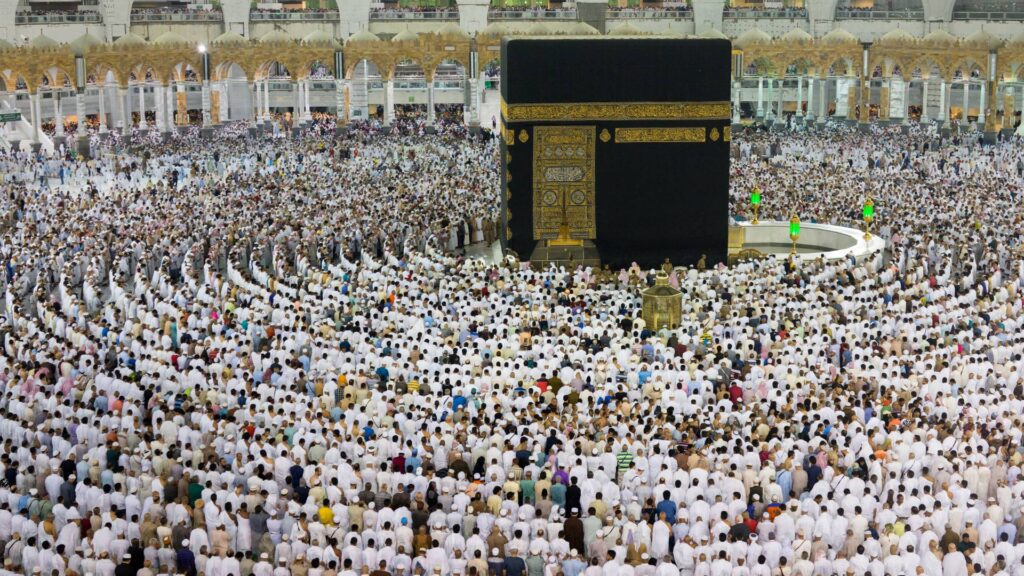
Upon arriving at Masjid al-Haram, the sight of the Kaaba, the cube-shaped structure draped in black and gold, is a moment pilgrims describe as breathtaking and tear-inducing.
Tawaf involves circling the Kaaba seven times counterclockwise, beginning and ending at the Black Stone (Hajr al-Aswad) in the eastern corner.
- If possible, kiss or touch the Black Stone at the start. If the crowd is too large, simply point toward it and say “Bismillah, Allahu Akbar.”
- During Tawaf, engage in sincere du’a (supplication), dhikr (remembrance of Allah), or recitation of Quran.
- Men are encouraged to perform Idtiba, draping the Ihram to expose the right shoulder during Tawaf.
- After completing seven rounds, offer two Rak’ahs of prayer near Maqam Ibrahim (the station of Abraham).
Step 3: Drink Zamzam Water
After Tawaf, drink from the Zamzam well water that has flowed miraculously for thousands of years and is believed to carry blessings and healing. Drink while standing, facing the Kaaba, and make du’a.
Step 4: Perform Sa’i — Walking Between Safa and Marwa
Sa’i is a walk between two small hills Safa and Marwa, located within the Grand Mosque. This ritual commemorates the extraordinary faith of Hajar (Hagar), wife of Prophet Ibrahim, who ran between these hills seven times searching for water for her infant son, Ismail (Ishmael).
- Begin at Safa, face the Kaaba, and make du’a.
- Walk to Marwa (this counts as one lap).
- Repeat until you complete seven laps, ending at Marwa.
- Men are encouraged to jog lightly between the green markers during each lap.
During Sa’i, reflect on Hajar’s unwavering trust in God. Her story is one of perseverance, faith, and divine mercy, universal values that transcend religion.
Step 5: Shave or Cut the Hair (Halq or Taqsir)
This final ritual marks the completion of Umrah and the exit from the state of Ihram.
- Men are recommended to shave their entire head (Halq) or cut it short (Taqsir).
- Women cut only a small portion, about an inch from the ends of their hair.
With this act, the restrictions of Ihram are lifted. You may resume normal clothing, use perfume, and return to daily activities.
After Umrah: Soaking in the Blessing
With Umrah complete, pilgrims are encouraged to:
- Spend time in Masjid al-Haram in prayer and reflection.
- Visit Masjid an-Nabawi in Madinah, the Prophet’s (S.A.W) Mosque, if time allows.
- Engage in ongoing du’a and gratitude throughout the remainder of the trip.
Many describe returning from Umrah with a profound sense of peace, clarity, and renewed purpose. It is not just a trip, it is a transformation.
Tips for American Travelers Performing Umrah
- Visa: Apply for an Umrah visa through a registered travel agent or the Nusuk platform (Saudi Arabia’s official platform).
- Best time to go: Avoid peak seasons like Ramadan if you prefer smaller crowds. Rajab and Sha’ban are quieter months.
- Health: Bring comfortable walking shoes for outside the Mosque, stay hydrated, and carry any medications you need.
- Language: Arabic is the primary language, but English is widely spoken in hotels and around the Haram.
- Currency: Saudi Riyal (SAR). USD can be exchanged at airports or banks.
Frequently Asked Questions (FAQs)
How long does Umrah take to complete?
The rituals of Umrah themselves can be completed in 3 to 6 hours, depending on crowd levels. Most travelers spend 7–14 days in Saudi Arabia to fully experience the journey.
Can non-Muslims perform Umrah or visit Makkah?
No. Entry into Makkah and Madinah is restricted to Muslims only. However, non-Muslims are welcome to learn about Islam and its practices through educational resources and interfaith dialogue.
Is Umrah obligatory in Islam?
Umrah is a Sunnah (recommended act), not obligatory like Hajj. However, most scholars highly encourage it for those who are financially and physically able.
What is the difference between Umrah and Hajj?
Hajj is the major pilgrimage with specific rituals performed on fixed dates in the Islamic calendar and is obligatory once in a lifetime for eligible Muslims. Umrah is the minor pilgrimage that can be performed any time of year and is voluntary.
Choose Experience Umrah, so that every traveler who embarks on this journey return with a heart full of peace, gratitude, and light.